How to choose a meal planner when you have a health condition
General information, not medical advice — your care team knows your labs and your limits. Full disclaimer.
Most apps in this space are trackers: you cook something, tell the app what you cooked, and it tells you how you did. That works if your problem is awareness. It works badly if your problem is the question at 5 p.m. — what do I cook tonight that fits a potassium limit, a protein floor, and three other people at the table?
A planner answers that before you shop, which matters most when a wrong dinner isn’t just a bad log entry. Six things to check before you trust any app with the job — including this one.
Can it hand you a week of dinners without you naming a single dish first? If the main screen is a diary, a barcode scanner or a photo button, it’s a tracker with a recipe section. The five-minute test: see whether the setup leaves you holding a shopping list you could take to a store.
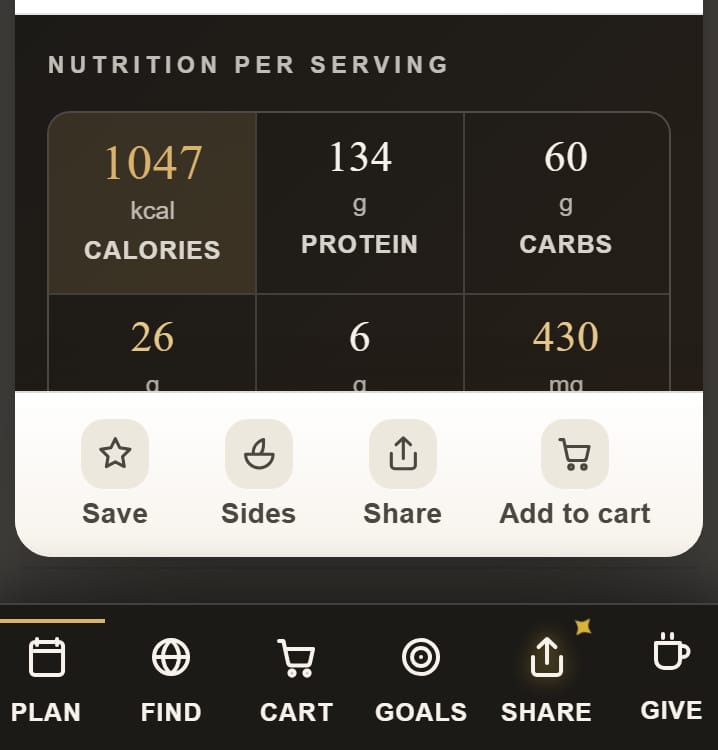
For most condition diets the hard numbers aren’t calories — they’re sodium, potassium and phosphorus, which are exactly the ones a recipe can least afford to guess. The five-minute test: pick any figure and try to trace it to a food. If nothing explains it, treat every number in that app as a sketch.
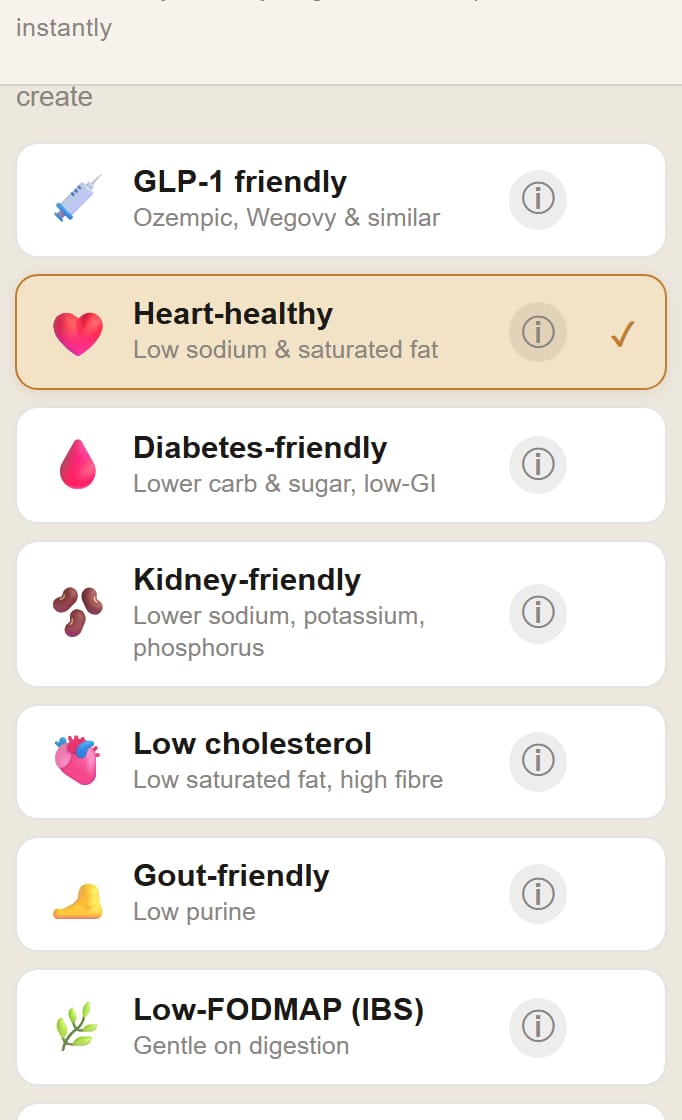
A calorie target is not a kidney diet. Renal planning needs potassium and phosphorus per serving; GLP-1 planning needs a protein floor; diabetes planning cares about the shape of the carbohydrate. The five-minute test: turn the condition on and see whether the food changes, or whether the app just prints a badge.
This is the failure nobody markets: the plan fits you and nobody else, so you cook twice — one of the most common reasons a condition-aware plan is abandoned in month two. What good looks like is one plan that respects the strictest need at the table and scales portions for everyone else.
Repetition is the most universal complaint in this category: plenty of planners are delightful for eight days and stale by day twenty. The five-minute test: generate two or three weeks back to back and read the dinner list.
Condition data is sensitive by definition. Look for plain answers: what leaves your device, whether you can export and delete everything, whether cancelling is a button or an email, and whether the free tier is genuinely usable or a demo with a wall.
It plans first — a week and a grocery list before you name a dish. Numbers are matched against a bundled USDA-derived dataset and shown with their working. Conditions change the food, not a badge. One plan feeds the whole table at full portions. It never repeats a dish it has planned for you. And a whole week costs no account, no ads and no data.
A tracker tells you what already happened; a planner decides what happens next. If you cook most of your meals and have a condition to respect, planning removes the decision that causes the trouble.
Only as far as its numbers can be traced. Ask where a potassium figure came from: a planner that matches each ingredient to a real food database can show you, and marks the lines it could not match. One that simply asserts the number cannot.
Whether it produces a shopping list without you naming the dishes. An app that can’t make the decision for you is not a planner.