How to share a meal plan with your family
General guidance. A shared plan carries the recipes and their numbers, not anyone’s health details — check what a tool includes before sending it on. Full disclaimer.
Meal plans get shared constantly and almost always badly — a screenshot in a group chat, a photo of a whiteboard, a spreadsheet nobody else opens. All of them share the answer (Tuesday is chilli) while withholding everything needed to act on it.
The person you send a plan to wants one of three things: to cook one dish from it, to shop for it, or to use the whole week themselves. A good share serves all three; a photo serves none.
The test is simple: can the person receiving it stand in a kitchen and produce dinner? A photo of a week grid fails immediately — it names dishes and hides recipes. This matters most for the partner who cooks on the nights you don’t.
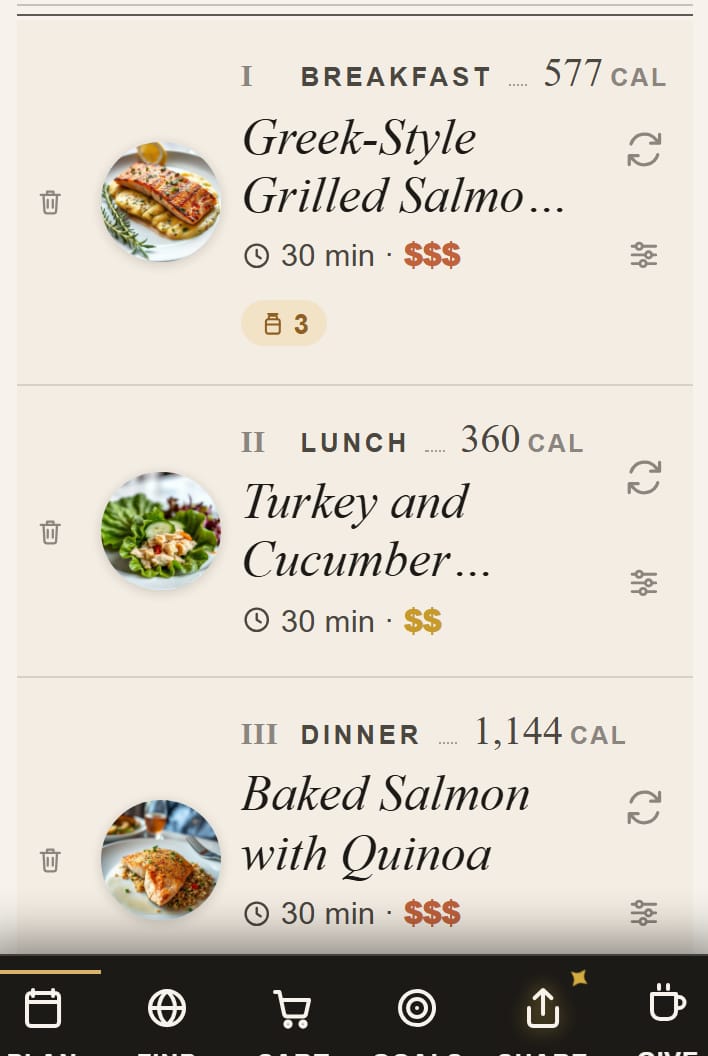
The most useful thing a shared plan can be is a starting point. Somebody sends you their week, you like five of the seven, and you want to keep those and change the rest. That’s a copy, not a view — without it, a shared plan is a suggestion the recipient has to retype.
Half the time the reason you’re sharing is that someone else is doing the shop. What they need isn’t the week — it’s the list: combined, deduplicated, sorted by aisle, as plain text they can open anywhere rather than an app-shaped object they have to install something to read.
Most sharing is one dish, not seven — “this was good, make it”. Sending an entire week to communicate one dinner puts the work of finding it on the other person.
A meal plan can carry more than food: the conditions it was built around, the people at your table, what a household eats. Most of that is nobody else’s business, so prefer a tool that shares the food and leaves the health details behind.
A link to the real plan, where every dish opens with its full recipe and per-serving nutrition, and nobody needs an account to open it. Anyone can remix it into their own week without touching yours. The grocery list copies as plain text or prints as a clean sheet. What the link does not carry: your table, your conditions, or your account.
A link that opens the real recipes, rather than a screenshot of a grid. The person receiving it wants to cook from it, shop for it, or adopt it — an image supports none of those.
They can if the tool supports copying it. In Plate Planner a shared plan can be remixed into the recipient’s own week, with your copy untouched.
Not with Plate Planner. A shared plan opens for anyone with the link; an account only matters if they want to keep and sync a plan of their own.
A Plate Planner share carries the dishes, their recipes and their nutrition — not the conditions behind the plan. With any other tool, check what travels with the link before you send it.