How to plan a week of meals
General guidance, not medical or dietary advice. If you have a health condition, the limits your care team sets always outrank anything an app suggests. Full disclaimer.
Most meal planning fails in the same place. Not at the recipes — at the decisions underneath them. Who is eating on Thursday, what cannot be on the plate, how many nights you will realistically cook, and what happens when Wednesday’s dinner turns out to be wrong.
This is the method, in the order the decisions actually depend on each other. You can follow it with a notebook; each step also says where it lives in Plate Planner.
A week built for one person that three people have to eat is a week you cook twice — the most common reason a plan is abandoned in its second month. Write down the people and, for each, what is genuinely non-negotiable: a diet, an allergy, a condition, a food they won’t touch. In the app this is Who’s eating, at Your table.
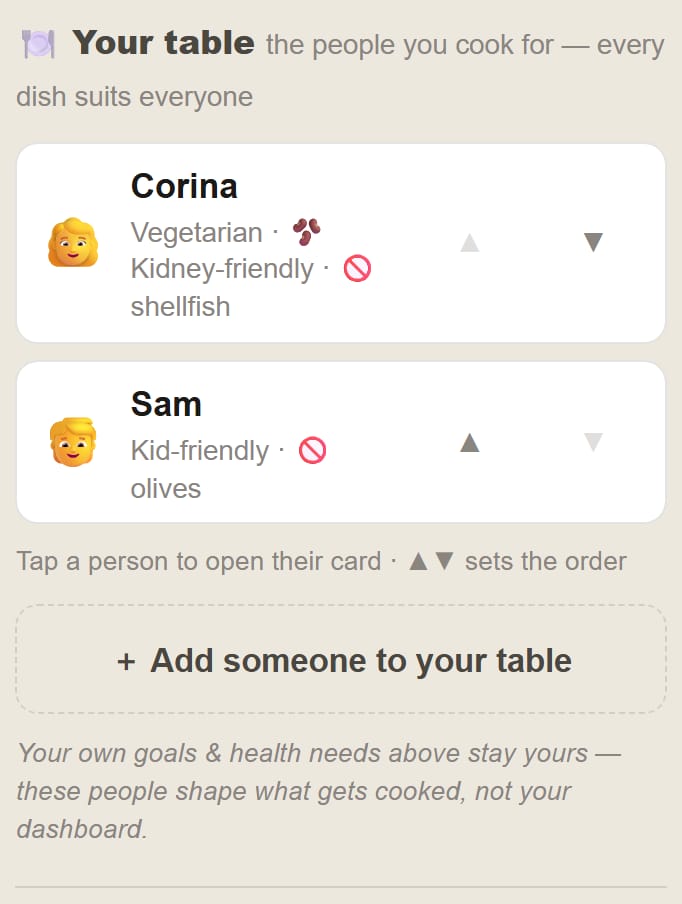
“We like Italian food” is a preference and should shape the week, not govern it. “No shellfish” and “under 1,500 mg of sodium a day” are rules, and a plan that breaks one isn’t slightly worse — it’s useless. Allergies are absolute: the app will never call a dish safe, but it won’t knowingly plan one containing what you listed.
A seven-day, three-meal grid is twenty-one decisions, and most households genuinely cook maybe eight of them. Planning the other thirteen produces a beautiful document describing somebody else’s life, and a grocery list full of food that rots.
The most destructive habit in meal planning is regenerating the whole week because two meals are wrong: you throw away the five dinners you were happy with, and the new week arrives with its own two problems. Planning again should fill the empty slots and leave everything else untouched.
When a week misses a target — protein too low, sodium too high, one night too expensive — the fix is almost always one or two meals, not seven. Fix my week names the meals responsible, shows what each swap would change, and waits for you to approve it.
You won’t want every dish, and a method that treats rejection as failure won’t survive a real week. A swap should give you properly different options for that slot — different main ingredient, method and cuisine — that still obey every rule from step 2. Breakfast swaps should return breakfast food, which is exactly what quietly goes wrong in AI planners.
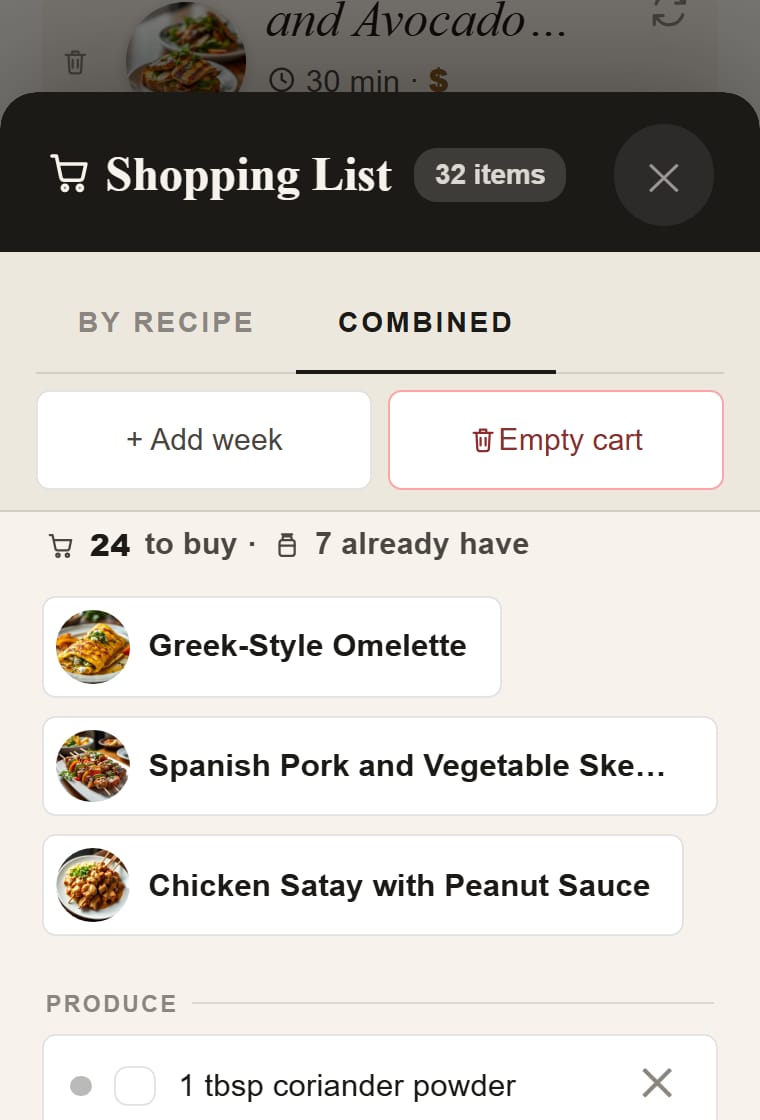
A plan you have to translate into a grocery list by hand is a plan you’ll stop making. The list should fall out of the week automatically: duplicates merged, grouped by aisle, and anything already in your kitchen subtracted.
Any method feels good for eight days. The test is day twenty-two, and the failure mode is repetition. If you plan manually, keep a running list of what you’ve served and refuse to repeat inside a month. Plate Planner keeps that record permanently and won’t serve the same dish twice.
One week suits most households: long enough for a single shop, short enough that life hasn’t changed underneath it. A fortnight tends to fail in the second week.
Only the ones you genuinely cook. If that’s five dinners and nothing else, plan five dinners. A short plan you follow beats a full grid you abandon on Tuesday.
Replace that meal, not the week. Swapping one dish keeps the rest of your plan and the shopping list you already built.
Yes, if it’s built around the strictest need at the table and portions are scaled for everyone else: one pan, one shopping list, nobody cooks twice.
Not in Plate Planner. You can plan a whole week, get the recipes and build the grocery list without signing up; an account only syncs between devices.