How to hit a protein or sodium target across a whole week
General information, not medical or dietary advice. Protein floors and sodium ceilings should come from your own clinician or dietitian — especially with kidney disease, where protein guidance is individual and sometimes counter-intuitive. Full disclaimer.
Most people meet a nutrition target the hard way: eat first, add it up afterwards, feel bad, try harder tomorrow. That’s a scoring system, not a plan, and it’s why the same target gets missed in the same way every week.
A target is a planning constraint. If a week is designed to land inside it, you hit it by cooking what you already decided to cook — and the counting afterwards stops being a verdict and becomes a receipt.
Protein is usually a floor — more is fine, less is the failure. Sodium is a ceiling. Calories are a window, where both directions count as missing. A floor is met by anchoring: pick the protein first and build the plate around it. A ceiling is met by budgeting it across the day. Raising a floor while holding a ceiling is the hard case, because the obvious high-protein convenience foods are also the salty ones.
Chasing a target meal by meal makes every plate a small exam and produces an anxious way of eating. A week has enough slack to absorb one heavy dinner if the days around it are built to. The exception is a hard clinical ceiling for a single day, such as a renal potassium limit — that’s a day-level rule, not a weekly average.
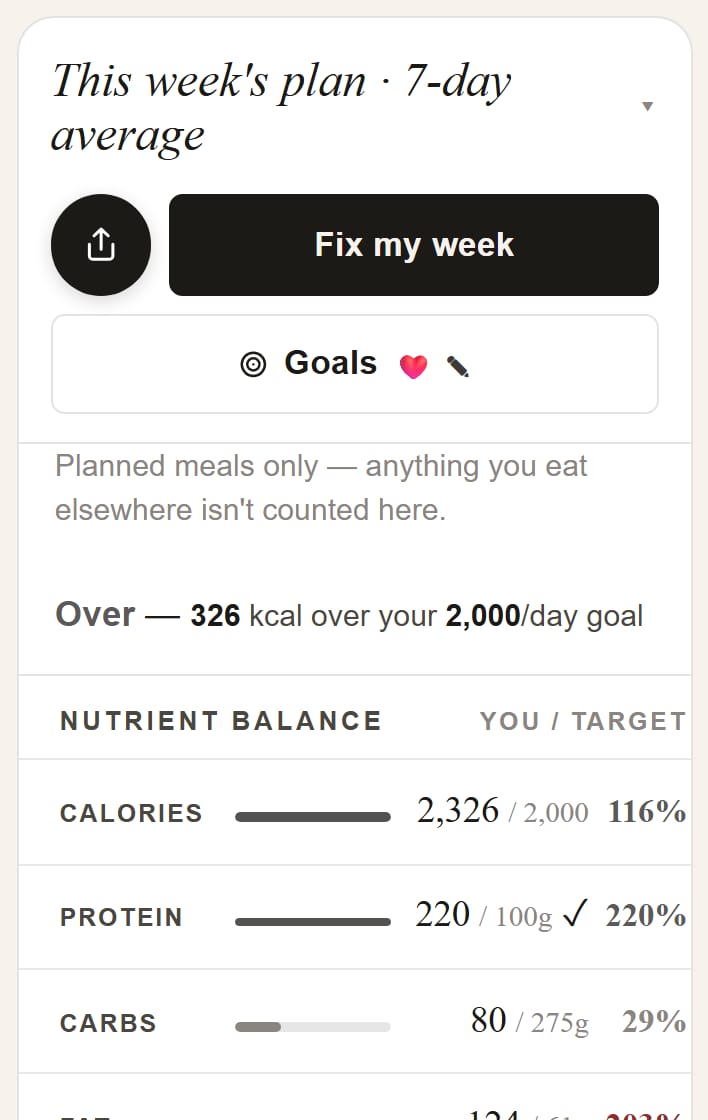
A dashboard that counts every dish on the calendar is lying to you the moment you cook for more than yourself. A family lasagne is not your dinner — one portion of it is, and if you’re cooking for four, three-quarters of that pan belongs to someone else’s numbers.
Every dashboard has a scope, and reading one without knowing its scope is how people end up cheerfully wrong. A planner counts the meals in the plan — what you intended to cook and, hopefully, did. It doesn’t know about the biscuits, the takeaway or the second coffee, and an honest tool should say so.
When a week misses, the instinct is to start over. Almost always one or two dishes carry the entire miss — a single salty dinner can put a day over a 1,500 mg ceiling on its own. Find the offender and replace only that: it’s faster, and it teaches you which dishes are expensive in the currency you’re spending.
A tidy dashboard built on invented figures is worse than no dashboard, because it converts a guess into confidence. This matters most for exactly the numbers people are given targets for — sodium, potassium, phosphorus — which are also the ones most panels leave out. Ask what each number is matched to before you trust the graph.
Each dish’s numbers are computed from a bundled USDA-derived dataset when its ingredient lines match, and carry a ✓ when they do; a figure the dataset could not confirm is marked with a ~ rather than dressed up as verified. Totals are shown per day and rolled up across the week and month, so you can see which days carry a problem. Only the servings eaten by the people whose numbers are shown get counted, so cooking for a household doesn’t inflate your own day. And Fix my week names the meals responsible for a miss, shows what a swap would change, and waits for your approval.
Plan weekly, check daily. A week has enough slack to absorb one heavy meal. The exception is a hard clinical limit for a single day, such as a renal potassium cap.
Plan the protein first and choose unprocessed sources — fresh meat, fish, eggs, pulses, plain dairy — because the convenient high-protein foods are usually the salty ones.
A planner counts what’s in the plan, not what went in your mouth. That’s fine as long as the tool says so, which is why these dashboards say planned meals only.
Because a recipe total is not a person’s intake. If you cook for four, one portion is yours and three belong to other people.